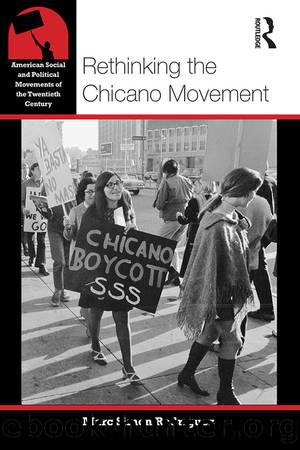
Rethinking the Chicano Movement by Marc Simon Rodriguez
Author:Marc Simon Rodriguez [Rodriguez, Marc Simon]
Language: eng
Format: epub
Tags: Social Science, Ethnic Studies, American, Hispanic American Studies, History, Social History, United States, 20th Century, General
ISBN: 9781136175374
Google: 2ydWBQAAQBAJ
Publisher: Routledge
Published: 2014-11-13T05:01:54+00:00
Bay Area Activism
In the Bay Area, San Francisco State College (SFSC) students took the lead in the push for Ethnic Studies and Chicano Studies in Northern California. In 1968, students at SFSC had established the Third World Liberation Front (TWLF) to push for the admission of more minority students and the creation of a Third World College to house a Raza Studies Department, among other minority-group-focused departments. In 1960, the state of California established a master plan that set percentage quotas for admission based on oneâs place in the high school graduating class, which negatively affected minority student admissions. The TWLF protested this restrictive policy and pressed for a Third World College. In the TWLF, Chicanos joined Filipinos, African Americans, and others in the effort to push for an open admissions policy and create what might today be termed Ethnic Studies. The students engaged in a strike movement that trained many of them in the production of posters, leaflets, mass meetings, sit-ins, and other demonstrations of massive resistance that led to many arrests. The strike succeeded in bringing about better minority recruitment and admissions policies and the 1969 creation of an Ethnic Studies Department that housed Black and Raza Studies. 29 This strike wave spread to the campus of the University of California, Berkeley, where similar protests took place, giving rise to the development of an interracial interethnic movement for Ethnic Studies at Californiaâs flagship state university. This was a dynamic time to be in the Bay Area, and students might have spent more time working on the UFW grape strike, the Third World strike, and activism than in the classroom. 30
At the University of California, Berkeley, where activist students emulated their peers at SFSC, a Third World strike began in 1969 with many of the same goals. The Berkeley TWLF protests began in January 1969 and demanded the creation of a Third World college, the recruitment of Third World faculty and students (minorities), and close ties to minority communities. The activists settled for an Ethnic Studies department. Ethnic Studies was, however, a successful effort at UC Berkeley, and the department expanded and flourished compared to most program efforts. MEChA students felt that vigilance was required and were aware of the constant need to âwake up and renew the revolutionary goals which founded the Ethnic Studies departmentâ and âserve students, faculty, and the community.â 31 At Stanford, there were fewer Chicano students, yet the Mexican American group on campus became a MEChA organization in 1969 and began the push for a Chicano-themed dormitory, a research library, and a fellowship program to recruit faculty. It would take longer for Stanford to institutionalize Chicano student services and a Chicano Studies program, but Stanford hosted many important MEChA events and its students and graduates became leaders in the field of Chicano education, history, and other related disciplines. 32
Download
This site does not store any files on its server. We only index and link to content provided by other sites. Please contact the content providers to delete copyright contents if any and email us, we'll remove relevant links or contents immediately.
| Anthropology | Archaeology |
| Philosophy | Politics & Government |
| Social Sciences | Sociology |
| Women's Studies |
Cecilia; Or, Memoirs of an Heiress — Volume 1 by Fanny Burney(32538)
Cecilia; Or, Memoirs of an Heiress — Volume 2 by Fanny Burney(31935)
Cecilia; Or, Memoirs of an Heiress — Volume 3 by Fanny Burney(31925)
The Great Music City by Andrea Baker(31911)
We're Going to Need More Wine by Gabrielle Union(19032)
All the Missing Girls by Megan Miranda(15925)
Pimp by Iceberg Slim(14476)
Bombshells: Glamour Girls of a Lifetime by Sullivan Steve(14046)
For the Love of Europe by Rick Steves(13866)
Talking to Strangers by Malcolm Gladwell(13341)
Norse Mythology by Gaiman Neil(13332)
Fifty Shades Freed by E L James(13228)
Mindhunter: Inside the FBI's Elite Serial Crime Unit by John E. Douglas & Mark Olshaker(9313)
Crazy Rich Asians by Kevin Kwan(9271)
The Lost Art of Listening by Michael P. Nichols(7486)
Enlightenment Now: The Case for Reason, Science, Humanism, and Progress by Steven Pinker(7303)
The Four Agreements by Don Miguel Ruiz(6739)
Bad Blood by John Carreyrou(6609)
Weapons of Math Destruction by Cathy O'Neil(6260)
